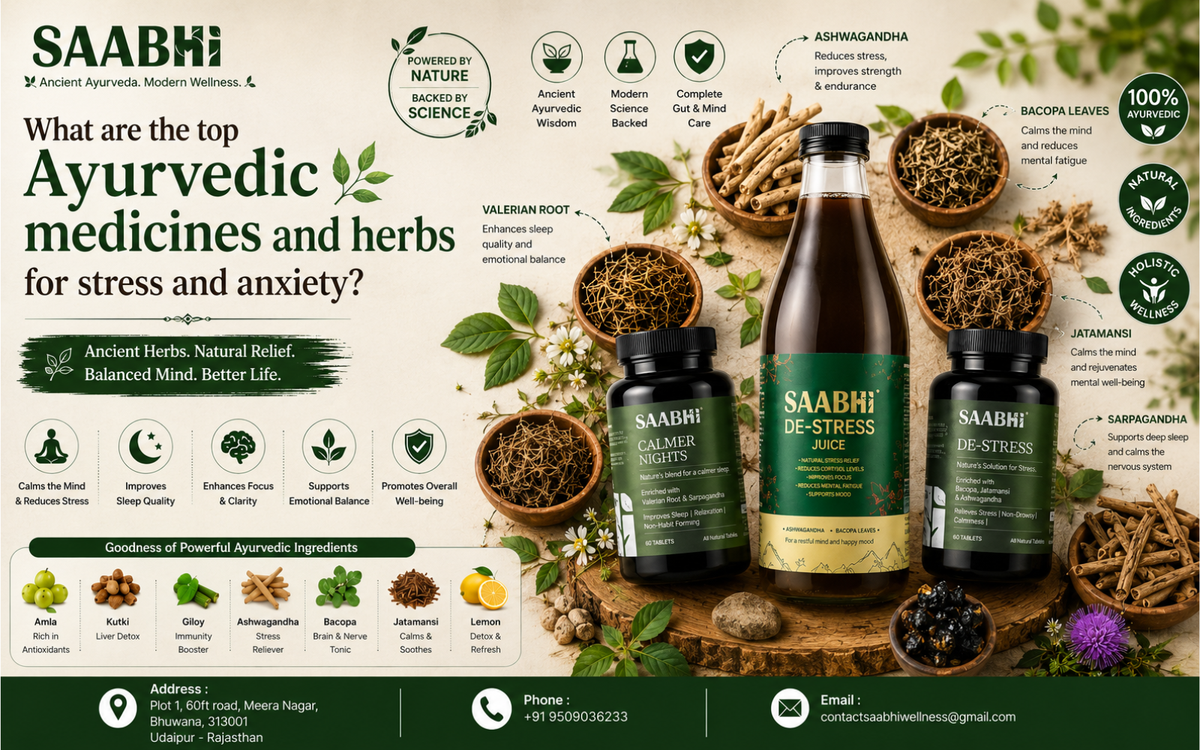
Stress shows up everywhere at once: in your sleep, stomach, patience and focus. Ayurveda sees it as disturbed Vata (restlessness) and aggravated Pitta (irritability), and uses calming, nourishing herbs alongside routine. Here is what each herb is used for and where the research stands.
Which Ayurvedic herbs are used for stress?
| Herb | Traditional use | Research so far | In Saabhi products |
|---|---|---|---|
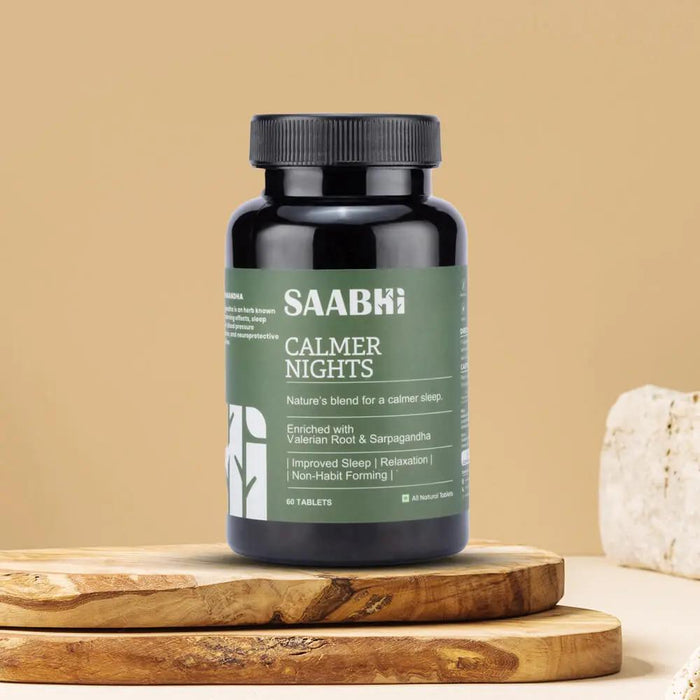
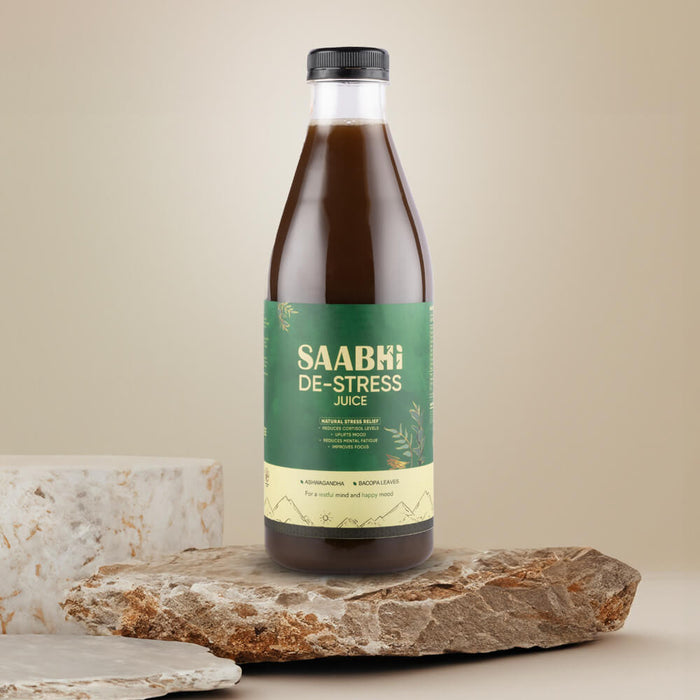
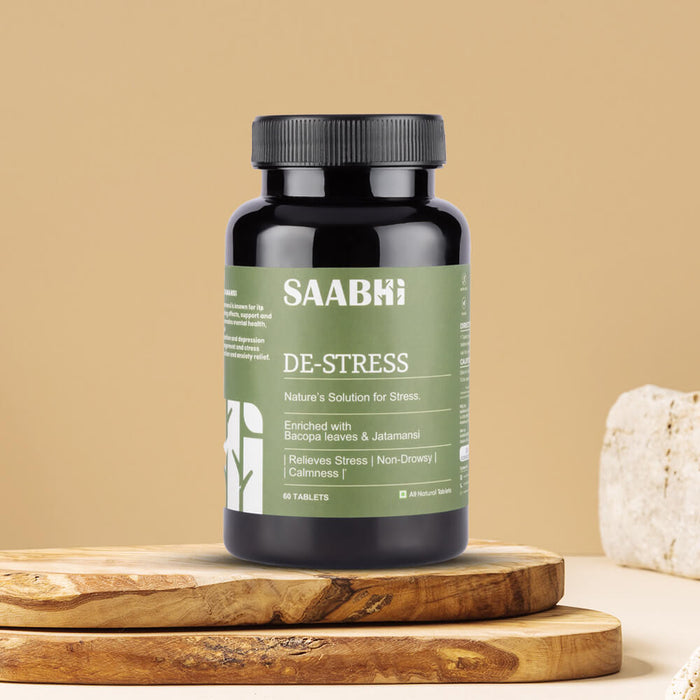
| Ashwagandha | Adaptogen: stress resilience, strength, sleep | Several randomised human trials | De-Stress Tablets 300 mg/tablet; Calmer Nights 200 mg/tablet; De-Stress Juice |
| Brahmi | Calm focus, memory | Human trials on attention and memory | De-Stress Tablets (processed with Brahmi); Calmer Nights 100 mg/tablet |
| Jatamansi | Settling a restless mind | Mostly lab and animal studies | De-Stress Tablets 100 mg/tablet; De-Stress Juice |
| Tagar (Indian valerian) | Evening calm and sleep | Valerian reviewed for sleep | De-Stress Tablets 100 mg; Calmer Nights 200 mg/tablet |
| Shankhpushpi | Mental calm, focus | Mostly traditional use | De-Stress Tablets 100 mg; Calmer Nights 100 mg/tablet |
| Vacha | Clarity and speech | Mostly traditional use | De-Stress Juice |
| Sarpagandha | Calming, classical night herb | Powerful; prescription-type herb | Calmer Nights 50 mg/tablet |
Ashwagandha
The most researched Ayurvedic herb for stress. In randomised, placebo-controlled trials, adults taking ashwagandha root extract reported lower stress and had lower cortisol than those on placebo [1, 2].
Brahmi
Brahmi (Bacopa monnieri) is traditionally used for a calm, focused mind. A 12-week trial in healthy adults found improvements in some measures of attention and memory [3].
Jatamansi
A Himalayan root traditionally used to settle the mind and support sleep. Reviews describe interesting lab findings but few human trials [4].
Tagar
Tagar (Valeriana wallichii) is a close relative of European valerian, which has been reviewed for sleep quality with mixed but encouraging results [5].
Sarpagandha
A classical calming herb that also lowers blood pressure. It needs care: avoid it with low blood pressure or with medicines for blood pressure, anxiety, depression or sleep, unless your doctor agrees.
How do I build a daily routine for stress?
- Morning: wake at a fixed time, get daylight, move for 20 minutes.
- Through the day: regular meals, short breathing breaks, no caffeine after 2 PM.
- Evening: light dinner, screens off 30 minutes before bed, a warm shower or foot massage with oil (padabhyanga).
- Herbs: De-Stress Tablets or De-Stress Juice for the day; Calmer Nights if sleep is the main issue. Give them 4 to 8 weeks.
What does the research say?
- Chandrasekhar K et al. (2012). Ashwagandha root extract in reducing stress and anxiety in adults. Indian J Psychol Med. PubMed
- Lopresti AL et al. (2019). The stress-relieving and pharmacological actions of an ashwagandha extract: a randomised, double-blind, placebo-controlled study. Medicine (Baltimore). PubMed
- Stough C et al. (2001). The chronic effects of an extract of Bacopa monniera (Brahmi) on cognitive function in healthy human subjects. Psychopharmacology. PubMed
- Pathak S et al. (2024). Nardostachys jatamansi: phytochemistry, ethnomedicinal uses and pharmacological activities: a comprehensive review. Fitoterapia. PubMed
- Bent S et al. (2006). Valerian for sleep: a systematic review and meta-analysis. Am J Med. PubMed
These studies used single-herb extracts at specific doses, not our blends.
When does stress need professional care?
Compare our three stress-care products in 3 Stress Care Products for Calmer Days, or visit the stress and sleep range.