Amla has been part of Indian kitchens for generations, as murabba, pickle, powder and now as ready-to-drink juice. Here is what it offers, what the research shows and when to drink it.
What is amla juice?
Amla juice is the pressed or extracted juice of the Indian gooseberry (Phyllanthus emblica, also called Emblica officinalis). It is sour, slightly bitter and astringent, so it is almost always diluted with water before drinking.
In Ayurveda, amla (amalaki) is one of the three fruits of triphala and is counted as a rasayana, taken regularly over time rather than as a quick fix.
What are the benefits of amla juice?
The main reason people drink amla juice is its natural vitamin C and polyphenols, which support the body's antioxidant defences. Beyond that, most of the evidence is early.
- Antioxidant support: reviews describe vitamin C and tannin-type polyphenols as amla's key compounds.
- Vitamin C from food: diluted juice is an easy way to add a vitamin C rich fruit to your day, though levels vary with processing.
- Digestion as a habit: amla is a traditional part of triphala, used to support regular digestion.
- Hair routines: amla is a classic in Indian hair oils; evidence for drinking it for hair is limited.
Amla juice is a food-based habit alongside a balanced diet, sleep and movement, not a substitute for medical care.
Is amla really high in vitamin C?
Yes, fresh amla contains a meaningful amount of vitamin C, but the level in a bottled juice depends on how the fruit was processed and stored. Vitamin C breaks down with heat, light and time.
One lab study measured about 0.4% vitamin C by weight in the fresh fruit and found that vitamin C explains only part of amla's antioxidant activity; its polyphenols account for much of the rest [2].
When should you drink amla juice?
Most people drink amla juice in the morning, diluted in a glass of water, often before breakfast. If the sour taste bothers your stomach, take it after breakfast instead. Consistency matters more than the exact time.
| Timing | How to take it | Good for | Tip |
|---|---|---|---|
| On waking, empty stomach | 20 to 30 ml in a glass of water | The traditional routine; easy to remember | Skip if you get acidity on an empty stomach |
| After breakfast | 20 to 30 ml in water | People with a sensitive stomach | Gentler than taking it first thing |
| Morning and bedtime | As per the label of a blend | Herbal blends with twice-a-day directions | Follow the pack, not a general rule |
Do not drink it neat, and rinse your mouth afterwards, since sour juices can be hard on tooth enamel.
How much amla juice should you drink a day?
For plain amla juice, 20 to 30 ml once or twice a day, diluted, is the common range. Start low and follow your bottle's label, since strength differs between brands.
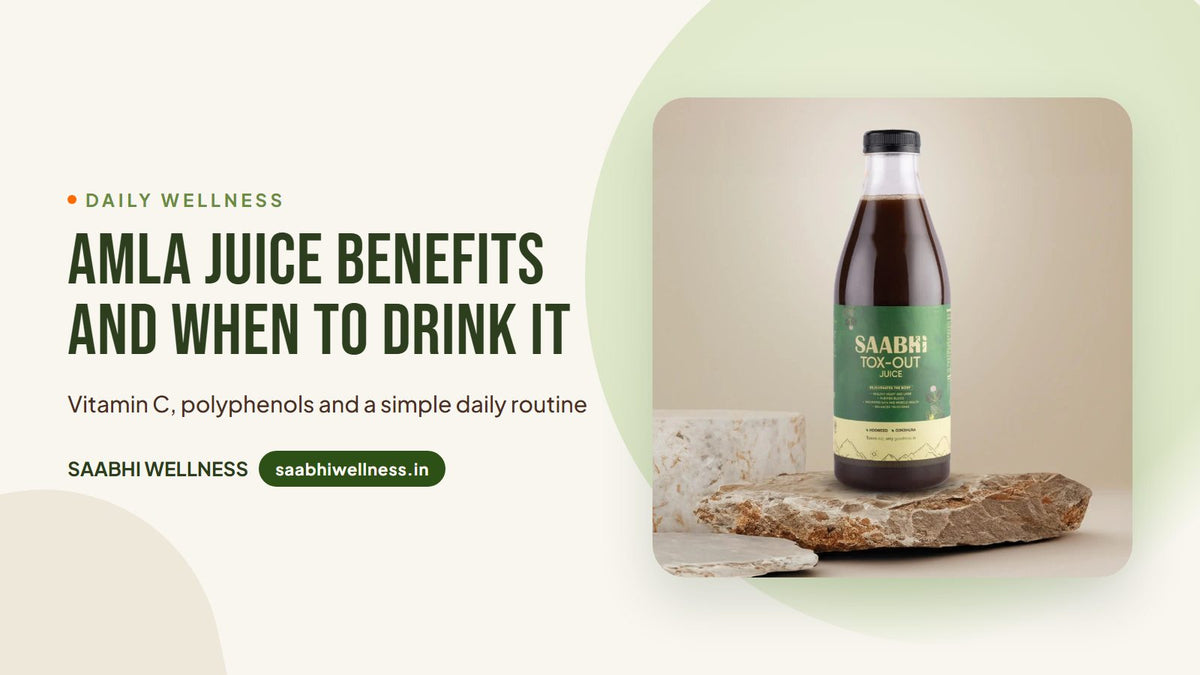
Blends have their own directions. Saabhi Tox-Out Juice, for example, pairs amla with haritaki and vibhitaki, the other two triphala fruits, plus seven more herbs. For those three fruits together, read triphala for digestion.
Does amla juice have side effects?
For most adults, diluted amla juice in food amounts is well tolerated. The common complaints are acidity or a sour stomach, loose stools and, for some, a dry feeling in the mouth.
Speak to your doctor before drinking amla juice regularly if you are pregnant or breastfeeding, take medicines for diabetes or blood thinning, have a history of kidney stones, have an ongoing stomach or kidney condition, or have surgery coming up.
What does the research say?
A 2022 review of amla describes polyphenols and vitamin C as its central compounds and links them with improved antioxidant status, while noting that much of the work comes from lab and animal studies [1]. A 2006 lab study measured amla's vitamin C content and showed that vitamin C accounts for roughly half to two-thirds of the fruit's antioxidant activity [2]. In a small 18-week randomised, double-blind, placebo-controlled crossover study, 15 healthy adults took 500 mg a day of an amla extract; the authors reported better blood fluidity and lower markers of oxidative stress, with no safety concerns seen [3]. That study was small and run by the extract's manufacturer.
These studies used specific amla extracts, fruit samples and doses, not any Saabhi product.
- Gul M et al. (2022). Functional and Nutraceutical Significance of Amla (Phyllanthus emblica L.): A Review. Antioxidants (Basel). Review. https://pubmed.ncbi.nlm.nih.gov/35624683/
- Scartezzini P et al. (2006). Vitamin C content and antioxidant activity of the fruit and of the Ayurvedic preparation of Emblica officinalis Gaertn. J Ethnopharmacol. Laboratory study. https://pubmed.ncbi.nlm.nih.gov/16226416/
- Kapoor MP et al. (2020). Clinical evaluation of Emblica Officinalis Gatertn (Amla) in healthy human subjects: Health benefits and safety results from a randomized, double-blind, crossover placebo-controlled study. Contemp Clin Trials Commun. Small randomised crossover trial. https://pubmed.ncbi.nlm.nih.gov/31890983/
Is there an easy way to add amla to your day?
Saabhi Wellness makes science-backed functional wellness drinks and supplements for stress, detox, gut, sleep and daily energy, in convenient daily formats with ingredients dosed for results.
Saabhi Tox-Out Juice contains Amla 300 mg per 10 ml, alongside Gokshura, Punarnava, Arjuna, Manjistha, Bhringraj, Haritaki and Vibhitaki at 300 mg each, Neem 200 mg and Pippali 100 mg. Take 30 ml twice a day, on waking and at bedtime. It has 0 g sugar per 30 ml in lab nutrition testing and is manufactured under AYUSH licence. It is a daily wellness juice, not a plain amla juice. Explore the full liver and detox range.
Frequently asked questions
What are the benefits of drinking amla juice daily?
Amla juice is naturally rich in vitamin C and polyphenols, which support the body's antioxidant defences. Taken daily in small, diluted amounts, it is an easy way to add a vitamin C rich fruit to your routine. Most research so far comes from lab, animal and small human studies.
Can I drink amla juice on an empty stomach?
Many people drink diluted amla juice on an empty stomach in the morning. Because it is sour, some people get acidity this way. If that happens, take it after breakfast instead and keep it diluted in water.
How much amla juice should I drink in a day?
For plain amla juice, 20 to 30 ml diluted in water, once or twice a day, is the common range. Always follow your bottle's label, start with the lower amount and do not drink it neat.
Who should not drink amla juice?
Check with a doctor before drinking amla juice regularly if you are pregnant or breastfeeding, take medicines for diabetes or blood thinning, have a history of kidney stones, have an ongoing stomach or kidney condition, or have surgery coming up.
Does Saabhi Tox-Out Juice contain amla?
Yes. Saabhi Tox-Out Juice contains Amla 300 mg per 10 ml, along with haritaki, vibhitaki and seven other herbs. Take 30 ml twice a day, on waking and at bedtime. It has 0 g sugar per 30 ml in lab nutrition testing and is manufactured under AYUSH licence.