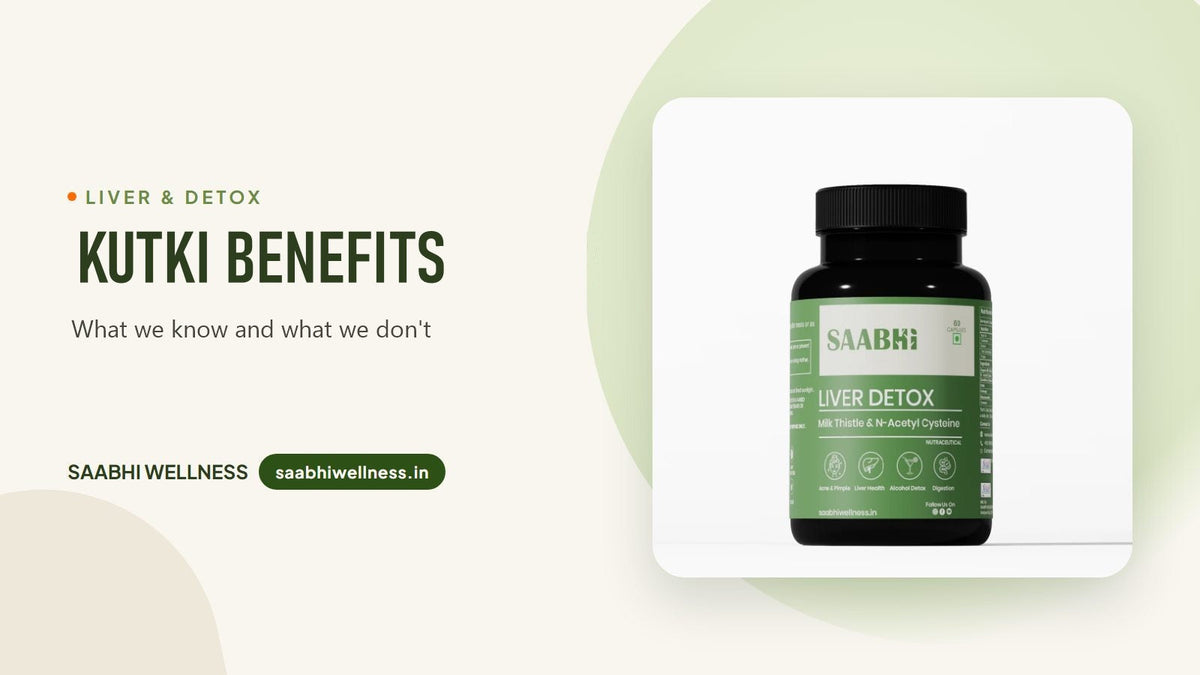
Kutki is one of the six actives in our Liver Detox Capsules, at 40 mg per daily serving. It's also the one fewest people have heard of. So here's what it is, what the research points to, and where the evidence runs out. It sits alongside the other topics in our guide to supporting your liver naturally.
What is Kutki?
Kutki is the common name for Picrorhiza kurroa Royle ex Benth, a medicinal plant used in Ayurveda for millennia, a review in the Journal of Ayurveda and Integrative Medicine notes, with certain cautions [1]. A separate review lists its traditional and folk uses, including jaundice, digestion, chronic constipation and liver stimulation [2].
It's also in short supply: researchers have described it as an endangered herb [3], which is one more reason to ask where a brand sources it.
What is in Kutki?
Researchers have identified glycosides, alkaloids, cucurbitacins, iridoids, phenolics and terpenes in the plant [2]. The iridoid glycosides, particularly the picrosides, have emerged as the active molecules [1].
What does the research say about Kutki and the liver?
Experimental and clinical studies have pointed to a liver-protective effect, which is why the plant has drawn renewed interest [1]. One review goes further and looks at how Kutki could become a standardised product for fatty liver disease [1].
Read that carefully, though. The same review describes this as potential that still needs work on how it acts, how well it works, how safe it is and what dose form suits it [1]. A second review presents itself as a resource for future basic and clinical research [2]. So: promising, and not settled.
Is Kutki a treatment for fatty liver?
No. Nothing we've reviewed shows Kutki treats or prevents fatty liver disease, and we don't claim it does. If you've been diagnosed, follow your doctor's plan and ask them before adding any herb. Our guide to the liver function test explains what your report numbers mean.
Is Kutki safe?
We can't give you a simple yes. Traditional texts use it with certain cautions [1], and the sources we reviewed for this post don't establish a safe daily dose for everyone. Speak to your doctor before taking it if you're pregnant or breastfeeding, have a medical condition or take regular medicines.
How much Kutki is in Saabhi Liver Detox Capsules?
Each daily serving of 2 capsules has 40 mg of Kutki, alongside Milk Thistle 400 mg (80% silymarin), NAC 200 mg, Bhumyamalaki 180 mg, Turmeric 100 mg and Dandelion 80 mg. The reviews above didn't test our product. For how the ingredients sit together, read Milk Thistle, NAC and Kutki. It's a daily wellness supplement, not a treatment.
Frequently asked questions
What is Kutki used for?
Traditionally, Kutki has been used for the liver, digestion, jaundice and chronic constipation, among other things. Modern research is mainly looking at its picroside compounds and liver protection, and that work isn't settled.
Is Kutki the same as Picrorhiza kurroa?
Yes. Kutki is the common name for the plant Picrorhiza kurroa, a bitter herb from the Himalayas.
Can Kutki cure liver disease?
No. It hasn't been shown to treat or cure liver disease. If you have a liver condition, follow your doctor's advice and check with them before taking any herb.
Sources
- Raut A et al. (2023). Picrorhiza kurroa, Royle ex Benth: Traditional uses, phytopharmacology, and translational potential in therapy of fatty liver disease. J Ayurveda Integr Med. PubMed
- Almeleebia TM et al. (2022). Pharmacological and Clinical Efficacy of Picrorhiza kurroa and Its Secondary Metabolites: A Comprehensive Review. Molecules. PubMed
- Mehta S et al. (2021). Advances in Ethnobotany, Synthetic Phytochemistry and Pharmacology of Endangered Herb Picrorhiza kurroa (Kutki): A Comprehensive Review (2010-2020). Mini Rev Med Chem. PubMed