Jatamansi turns up in many Indian stress and sleep formulas, often with big promises attached. Here is what it is, what it has traditionally been used for, and how far the evidence actually goes.
What is jatamansi?
Jatamansi is a small flowering plant from the high Himalayas, and its aromatic root is the part used. In Ayurveda it is valued as a calming herb for the mind, and it is also known as muskroot or Indian spikenard.
Researchers describe it as critically endangered in the wild, so quality and identity deserve attention [3].
What are the benefits of jatamansi?
The main traditional uses of jatamansi are supporting a settled mind during stressful periods and restful sleep at night. These uses come from long tradition, and modern research has only partly tested them.
- Calm: traditionally taken when the mind feels restless or overworked. We did not find strong human trials on everyday stress.
- Sleep: used in the evening as part of a wind-down. This is where the small amount of human research sits.
Does jatamansi help you sleep?
It may support sleep, but the evidence is early and comes from small studies. Jatamansi cannot yet be called a researched sleep aid in the way ashwagandha, which has several placebo-controlled trials, can.
Sleep habits come first: a fixed wake-up time, morning daylight, no caffeine after lunch and dim lights after dinner. Our guide to natural alternatives to melatonin covers these step by step.
How is jatamansi different from similar calming herbs?
Jatamansi is one of several calming herbs in Ayurveda, and they are often combined. The main difference between them is how much human research each one has.
| Herb | Traditional use | Research in people | Found in (Saabhi) |
|---|---|---|---|
| Jatamansi | Calm mind, restful sleep | Very limited, small studies | De-Stress Tablets, De-Stress Juice |
| Tagar (Indian valerian) | Night-time calm | Limited; more studies on European valerian, with mixed results | De-Stress Tablets, De-Stress Juice, Calmer Nights |
| Ashwagandha | Stress resilience, rest | Several randomised trials | De-Stress Tablets, De-Stress Juice, Calmer Nights, Strong 9 |
| Brahmi | Focus, settled mind | Several trials, mostly on memory and attention | De-Stress Tablets, De-Stress Juice, Calmer Nights |
Is jatamansi the same as tagar?
No. Jatamansi is Nardostachys jatamansi, while tagar is Valeriana jatamansi (also called Valeriana wallichii), a different plant that shares part of the name.
The mix-up is a real problem. A review noted that the two share identical local names and very similar lab profiles, so some older studies may not have tested the plant they named [3].
What does the research say?
The research is early: mostly animal work and small human studies.
Animal study: in small groups of rats and mice, jatamansi root powder reduced movement in rats. Mice given a sedative drug fell asleep sooner and slept longer, with no loss of muscle coordination [1]. Animal results often do not carry over to people.
Small human study: 30 adults with a diagnosed sleep complaint completed one month on either jatamansi or tagar powder, 4 g three times a day with milk. Both groups reported better sleep, and the tagar group did better. There was no placebo group and only 15 people per group, so it does not show that jatamansi treats any sleep disorder [2].
Review: a 2020 review found that human clinical trials and animal toxicology studies are largely missing, and that sample identity is a recurring weakness [3].
Blood pressure: in a single-blind trial, 40 adults with high blood pressure took 3 g of jatamansi a day or placebo for 4 weeks, and readings fell more with jatamansi [4]. This is a reason for caution if you take blood pressure medicines, not a reason to use it for blood pressure.
These studies used specific preparations and doses. None tested any Saabhi product.
- Panara K et al. (2020). Central nervous system depressant activity of Jatamansi (Nardostachys jatamansi DC.) rhizome. Ayu. Animal study. https://pubmed.ncbi.nlm.nih.gov/35813358/
- Toolika E et al. (2015). A comparative clinical study on the effect of Tagara (Valeriana wallichii DC.) and Jatamansi (Nardostachys jatamansi DC.) in the management of Anidra (primary insomnia). Ayu. Small comparative study, no placebo. https://pubmed.ncbi.nlm.nih.gov/26730138/
- Dhiman N et al. (2020). Nardostachys jatamansi (D.Don) DC.-Challenges and opportunities of harnessing the untapped medicinal plant from the Himalayas. J Ethnopharmacol. Review. https://pubmed.ncbi.nlm.nih.gov/31533076/
- Bhat MDA et al. (2020). Efficacy of Nardostachys jatamansi (D.Don) DC in essential hypertension: A randomized controlled study. Complement Ther Med. Small single-blind randomised trial. https://pubmed.ncbi.nlm.nih.gov/33066862/
Who should be careful with jatamansi?
Most people should check with a doctor first if they take regular medicines, because safety data on jatamansi are limited.
Which Saabhi products contain jatamansi?
Saabhi Wellness makes science-backed functional wellness drinks and supplements for stress, detox, gut, sleep and daily energy, in convenient daily formats with ingredients dosed for results.
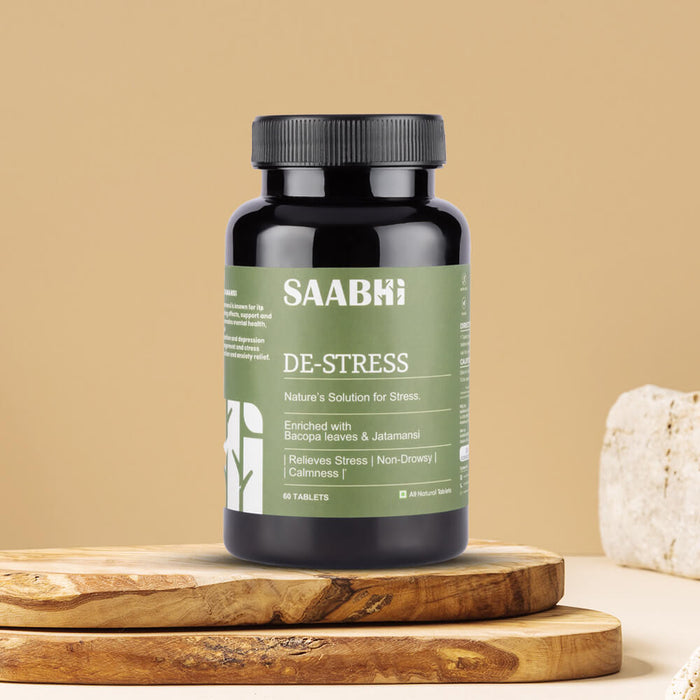
De-Stress Tablets: each tablet has Ashwagandha 300 mg, Jatamansi 100 mg, Tagar 100 mg and Shankhpushpi 100 mg, processed with Brahmi 500 mg. Take 1 tablet twice a day after meals.
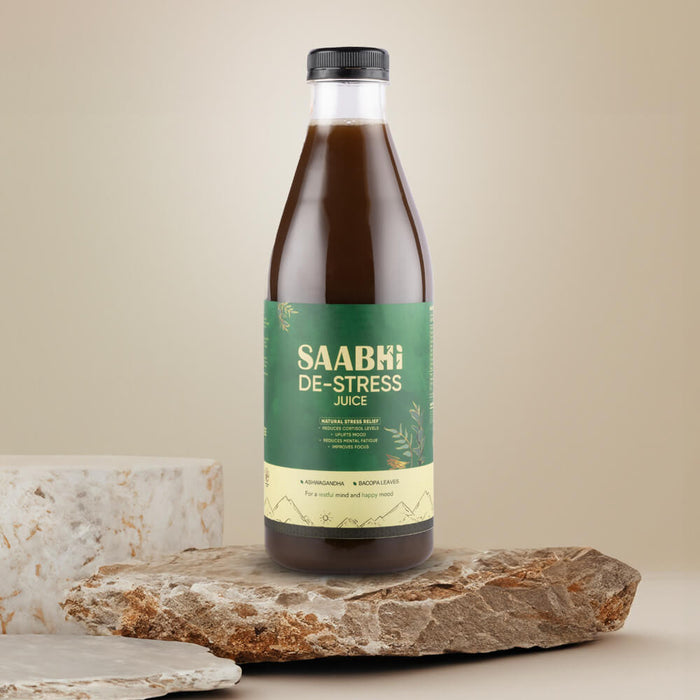
De-Stress Juice: each 10 ml has Ashwagandha 2000 mg, Jatamansi 500 mg, Tagar 500 mg, Shankhpushpi 250 mg, Brahmi 250 mg and Vacha 250 mg. Take 30 ml twice a day, morning and night.
Both are for adults 18+ and are wellness supplements, not treatments. Their daily jatamansi is lower than the 12 g of powder a day in the sleep study above, because jatamansi is one of several herbs.
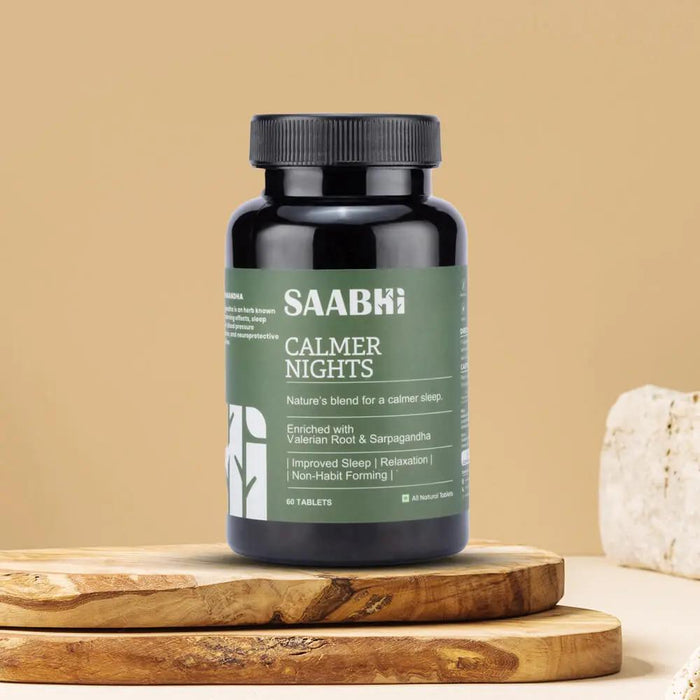
Calmer Nights, our night-time tablet, does not contain jatamansi; it uses Tagar and Ashwagandha instead. It also contains Sarpagandha, a strong herb: do not take it without a doctor's advice if you have low blood pressure, take blood pressure, antidepressant, sleep or anxiety medicines, have a history of depression, or are pregnant or breastfeeding.
Explore the stress and sleep range.
Frequently asked questions
What is jatamansi used for?
Jatamansi is a Himalayan root used in Ayurveda to support a calm mind and restful sleep. These uses are traditional. Modern research is limited to animal work and small human studies, so the evidence is still early.
Does jatamansi make you sleepy?
It may. Jatamansi is traditionally used as a calming herb, and an animal study found longer sleep in mice given a sedative drug. Human data are limited, so see how you feel before driving and do not combine it with alcohol or sleeping pills.
How much jatamansi should I take?
There is no well-established daily amount, as large trials are missing. Follow the label of the product you use. Saabhi De-Stress Tablets have Jatamansi 100 mg per tablet, taken twice a day, as part of a multi-herb formula for adults 18+.
Who should not take jatamansi without a doctor's advice?
Ask a doctor first if you are pregnant or breastfeeding, take medicines for blood pressure, mood, anxiety or sleep, have a long-term condition, or have surgery planned. Safety data on jatamansi are limited, and one small trial saw lower blood pressure readings at 3 g a day.