Melatonin has become a common bedtime habit, but many people would rather not take a hormone every night. Here is what melatonin does, and the natural options worth trying first.
What does melatonin actually do?
Melatonin is a hormone your brain releases in the evening as light fades. It tells your body clock that night has started; it is a timing signal more than a sleeping pill.
So melatonin supplements are mostly used for timing problems such as jet lag. If you lie awake because you are stressed or wired, a timing signal may not be what you need. Because it is a hormone, ask a doctor before using it regularly.
What are the natural alternatives to melatonin?
The strongest alternatives are free: light, timing and a wind-down routine. Herbs come second, supporting a good routine rather than replacing it.
| Option | How it helps | How to use it | Research |
|---|---|---|---|
| Morning daylight | Sets your body clock so melatonin rises on time at night | 10 to 20 minutes outdoors within an hour of waking | Well established body-clock science |
| Dim evening light, fewer screens | Bright light in the evening delays your own melatonin | Warm, low lights and phone away 30 to 60 minutes before bed | Well established |
| Fixed wake-up time | Keeps the body clock steady, even after a late night | Same time every day, weekends included | Core part of sleep-hygiene advice |
| Ashwagandha | Adaptogenic root traditionally used for rest and stress resilience | Standardised extract or a formula, taken daily for several weeks | Several randomised trials; see below |
| Tagar (Indian valerian) | Root traditionally used in Ayurveda to calm the mind at night | Usually in combination formulas | Studies are on European valerian and are mixed |
| Brahmi and shankhpushpi | Traditional herbs for a calm, settled mind | Usually in combination formulas | Little sleep-specific research |
Which habits help your body make its own melatonin?
Your body already makes melatonin every night; most habits simply stop you from blocking it. Try these for two to three weeks:
- Get daylight early, for example tea on the balcony.
- Keep the same wake-up time every day.
- Stop caffeine after lunch, including chai and colas.
- Eat dinner 2 to 3 hours before bed.
- Dim the lights after dinner and charge the phone outside the bedroom.
- Keep the room cool, dark and quiet.
- Wind down for 20 minutes with a warm shower, slow breathing or a book.
Do herbs like ashwagandha and tagar help with sleep?
Ashwagandha has the most human research of the traditional sleep herbs, and trials suggest it may support sleep quality over several weeks. Evidence for valerian, the European cousin of tagar, is more mixed.
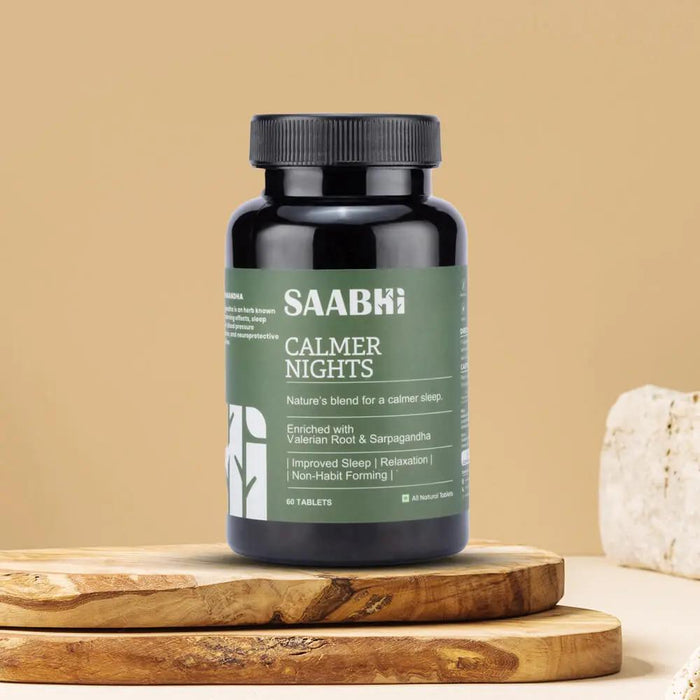
Unlike melatonin, these herbs are not a timing signal. Ayurveda uses them to settle a restless mind, often with brahmi and shankhpushpi in night-time formulas such as Calmer Nights. Judge them after several weeks, not one night.
What does the research say?
A systematic review and meta-analysis of 5 randomised controlled trials (400 adults) found a small but significant effect of ashwagandha extract on overall sleep versus placebo, larger at 600 mg a day or more and over at least 8 weeks. No serious side effects were reported, though long-term safety data are limited [1].
In a randomised, placebo-controlled trial in 150 healthy adults with unrefreshing sleep, 120 mg a day of a standardised ashwagandha extract for six weeks improved self-reported sleep quality and total sleep time more than placebo [2].
A meta-analysis of 16 valerian trials (Valeriana officinalis, not Indian tagar) found it might improve sleep quality, but most studies had methodological problems [3].
These studies used specific extracts and doses. None tested any Saabhi product, and they do not show that any herb treats a sleep disorder.
- Cheah KL et al. (2021). Effect of Ashwagandha (Withania somnifera) extract on sleep: A systematic review and meta-analysis. PLoS One. Systematic review and meta-analysis. https://pubmed.ncbi.nlm.nih.gov/34559859/
- Deshpande A et al. (2020). A randomized, double blind, placebo controlled study to evaluate the effects of ashwagandha (Withania somnifera) extract on sleep quality in healthy adults. Sleep Med. Randomised controlled trial. https://pubmed.ncbi.nlm.nih.gov/32540634/
- Bent S et al. (2006). Valerian for sleep: a systematic review and meta-analysis. Am J Med. Systematic review and meta-analysis. https://pubmed.ncbi.nlm.nih.gov/17145239/
When should I see a doctor about sleep?
See a doctor if poor sleep lasts more than three weeks or affects your work, mood or driving.
Is there an easy way to take these herbs at night?
Saabhi Wellness makes science-backed functional wellness drinks and supplements for stress, detox, gut, sleep and daily energy, in convenient daily formats with ingredients dosed for results.
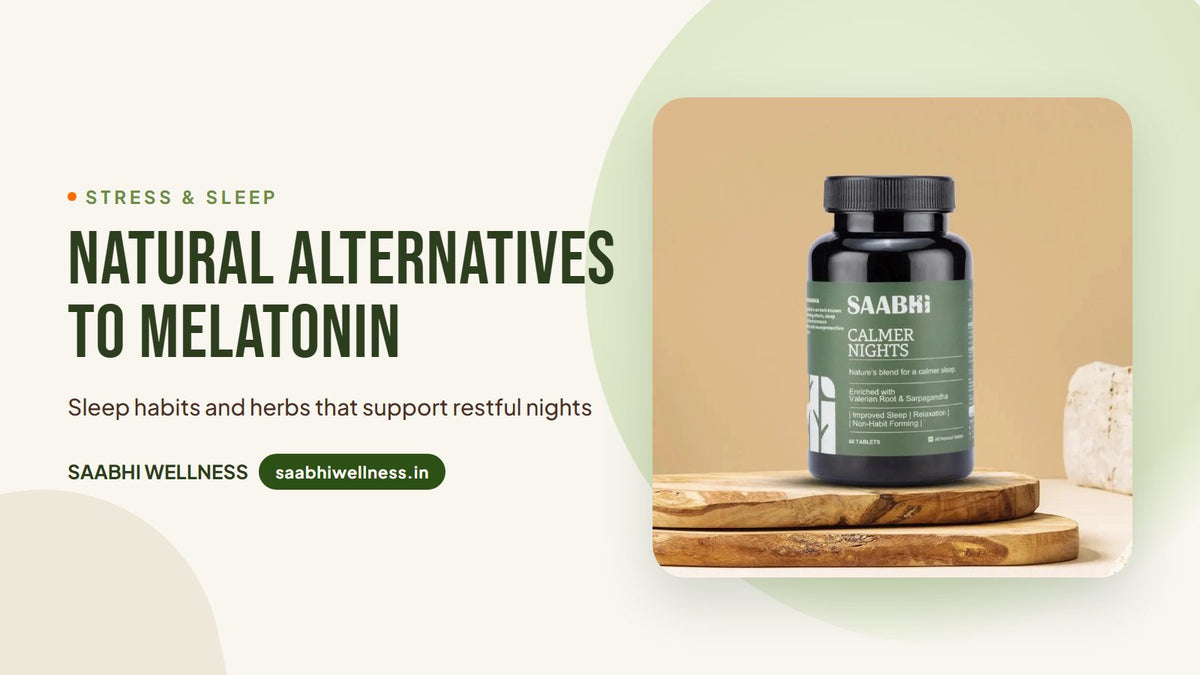
Saabhi Calmer Nights is a night-time herbal tablet. Each tablet contains Ashwagandha 200 mg, Tagar 200 mg, Brahmi 100 mg, Shankhpushpi 100 mg and Sarpagandha 50 mg, processed with Shankhpushpi 300 mg and Brahmi 300 mg. Take 1 tablet twice a day after meals. Its daily ashwagandha (400 mg) is below the 600 mg level in the review above, as it is one of several herbs. It is a wellness supplement to use alongside the habits above, not a treatment.
Sarpagandha caution: Calmer Nights contains Sarpagandha (Rauvolfia serpentina), a strong herb. Do not take it without a doctor's advice if you have low blood pressure, take blood pressure medicines, antidepressants or sleep or anxiety medicines, have a history of depression, or are pregnant or breastfeeding. It is not meant for children.
Explore the stress and sleep range, or read why you wake up at 3 AM for more night-time habits.
Frequently asked questions
What can I take instead of melatonin?
Start with habits that help your body make its own melatonin: morning daylight, a fixed wake-up time, no caffeine after lunch, and dim lights before bed. Herbs such as ashwagandha and tagar are traditionally used to support restful sleep, and ashwagandha has the most research of the two.
Is ashwagandha a good alternative to melatonin?
They work differently. Melatonin is a hormone that signals night-time to the body clock, while ashwagandha is an adaptogenic herb traditionally used for stress resilience and rest. A meta-analysis of 5 randomised trials found a small but significant effect of ashwagandha extract on overall sleep, mainly over 8 weeks or more.
How long do natural sleep herbs take to work?
Herbs like ashwagandha work gradually. The trials cited here ran for six to eight weeks or more, so give a herbal formula several weeks of regular use, along with good sleep habits, before judging it.
Who should not take Calmer Nights?
Calmer Nights contains Sarpagandha, so people with low blood pressure, those on blood pressure, antidepressant, sleep or anxiety medicines, anyone with a history of depression, and pregnant or breastfeeding women should not take it without a doctor's advice. It is not meant for children.