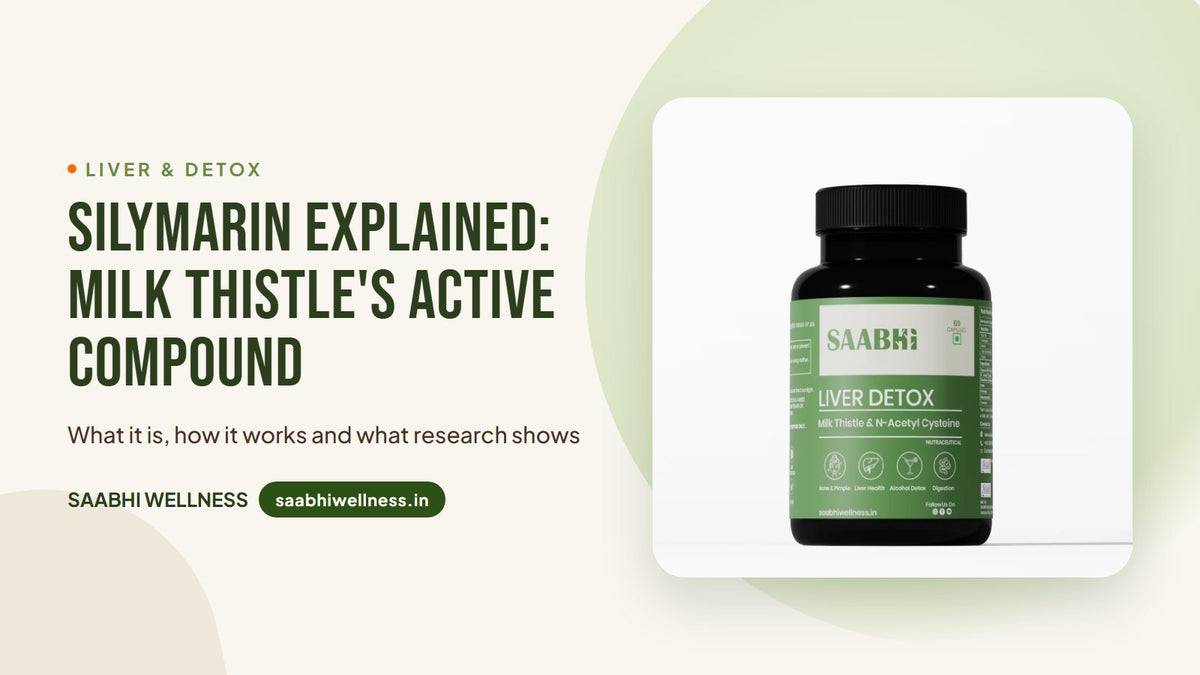
Many liver supplement labels in India say "milk thistle extract, 80% silymarin". Here is what silymarin is, how it is thought to work, and what the research does and does not show. For the wider picture, read our guide to supporting your liver naturally.
What is silymarin?
Silymarin is the mix of active compounds extracted from the seeds of the milk thistle plant (Silybum marianum). It is not one molecule but a family of flavonolignans, mainly silybin (also called silibinin), plus isosilybin, silychristin and silydianin.
Milk thistle is a spiky, purple-flowered plant from the daisy family (Asteraceae). Most research and supplements use a seed extract "standardised" to a set percentage of silymarin.
How does silymarin support the liver?
Silymarin is mainly studied as an antioxidant: it helps the body keep oxidative stress in check, and the liver is where much of that work happens. Most of what we know about how it works comes from lab and animal studies.
Your liver processes food, alcohol and medicines every day, which creates reactive by-products called free radicals. A review of the evidence describes several ways silymarin may help: mopping up free radicals directly, helping cells switch on their own antioxidant enzymes (through a signalling pathway called Nrf2), and supporting the body's glutathione system [1]. Glutathione is the same antioxidant that NAC helps the body make, which is why the two are often paired. You can read more in our guide to NAC benefits for the liver.
Why does silymarin absorption matter?
Silymarin is poorly absorbed: only a small part of what you swallow reaches the bloodstream, and the body breaks it down quickly. That is why the form and amount on the label matter more than the word "milk thistle" alone.
A review from researchers at Jamia Hamdard, New Delhi, describes silymarin's low solubility and rapid breakdown, and looks at formulation methods such as phytosomes and liposomes [2]. The practical point: a standardised extract gives you a known amount of silymarin, while plain milk thistle powder may contain very little.
How do I read a milk thistle label?
Check the extract ratio, silymarin percentage, amount per daily serving and lab testing. This table explains each term.
| Label term | What it means | What to check |
|---|---|---|
| Extract ratio (e.g. 30:1) | About 30 parts of raw seed were used to make 1 part of extract | A ratio is listed, not just "milk thistle powder" |
| Standardised to X% silymarin | The extract is tested to contain a set share of silymarin | A clear percentage, commonly 70–80% |
| Silymarin vs silybin | Silybin is the main compound inside silymarin | Do not compare a "silybin" dose directly with a "silymarin" dose |
| Amount per serving | How much extract you take in a day | Whether the amount is per capsule or per daily serving |
| Lab testing | Third-party tests for contaminants such as heavy metals | A named lab and a report you can see |
As an example, Saabhi Liver Detox Capsules list Organic Milk Thistle 400 mg (30:1, 80% silymarin) per daily serving of 2 capsules, and the capsules were tested for heavy metals at Eurofins.
What does the research say?
Lab evidence for silymarin as an antioxidant is consistent, but human results on liver outcomes are mixed. A review summarises the antioxidant mechanisms, mostly from cell and animal studies [1], and a second review confirms poor oral absorption [2]. A systematic review and meta-analysis of 14 placebo-controlled trials in people with chronic liver disease found no clear improvement in mortality, liver biopsy findings or most liver blood tests, though milk thistle was safe and well tolerated [3]. A safety review reports that silymarin is well tolerated in humans, with mild stomach upset the most common side effect, and that it has few drug interactions but needs caution with some medicines [4].
These studies used specific extracts, doses and patient groups. None of them tested any Saabhi product, and none shows that silymarin treats or prevents liver disease.
- Surai PF (2015). Silymarin as a Natural Antioxidant: An Overview of the Current Evidence and Perspectives. Antioxidants (Basel). Review. https://pubmed.ncbi.nlm.nih.gov/26785346/
- Javed S et al. (2011). Reassessing bioavailability of silymarin. Altern Med Rev. Review. https://pubmed.ncbi.nlm.nih.gov/21951025/
- Jacobs BP et al. (2002). Milk thistle for the treatment of liver disease: a systematic review and meta-analysis. Am J Med. Systematic review and meta-analysis. https://pubmed.ncbi.nlm.nih.gov/12427501/
- Soleimani V et al. (2019). Safety and toxicity of silymarin, the major constituent of milk thistle extract: An updated review. Phytother Res. Review. https://pubmed.ncbi.nlm.nih.gov/31069872/
Is silymarin safe to take every day?
For most healthy adults, silymarin is well tolerated at supplement amounts. The most common side effects are mild, such as nausea or loose stools [4].
People allergic to daisy-family plants such as marigold or ragweed may react to it. Evidence in pregnancy is limited, and silymarin may interact with some medicines that need precise dosing, so ask your doctor first in these cases.
How can I get silymarin with NAC in one daily capsule?
Saabhi Wellness makes science-backed functional wellness drinks and supplements for stress, detox, gut, sleep and daily energy, in convenient daily formats with every dose listed. Saabhi Liver Detox Capsules combine Organic Milk Thistle 400 mg (30:1, 80% silymarin) with N-Acetyl-L-Cysteine 200 mg, Bhumyamalaki 180 mg, Turmeric 100 mg, Dandelion 80 mg and Kutki 40 mg in each daily serving of 2 capsules.
Take 1 capsule twice a day after meals. The capsules carry FSSAI Lic. No. 12225999000701, and heavy metals were tested at Eurofins (NABL-accredited) and found within FSSAI limits. They are a daily wellness supplement, not a treatment. Explore the full liver and detox range.
Frequently asked questions
What are the benefits of silymarin?
Silymarin, the active compound group in milk thistle seeds, works mainly as an antioxidant. Lab and animal research suggests it supports the liver's normal defences against oxidative stress, including the glutathione system. Human results on liver outcomes are mixed, so it is a daily wellness ingredient, not a treatment for liver disease.
Is silymarin the same as milk thistle?
Not exactly. Milk thistle is the plant; silymarin is the group of active compounds extracted from its seeds, with silybin as the main one. Supplements usually use a seed extract standardised to a set percentage of silymarin, such as 80%.
How much milk thistle is in Saabhi Liver Detox Capsules?
Saabhi Liver Detox Capsules contain Organic Milk Thistle 400 mg (30:1, 80% silymarin) per daily serving of 2 capsules, together with NAC 200 mg, Bhumyamalaki, Turmeric, Dandelion and Kutki. Take 1 capsule twice a day after meals.
Why is silymarin absorption low?
Silymarin dissolves poorly in water and the body breaks it down quickly, so only a small part of an oral dose reaches the bloodstream. That is why supplements use standardised extracts with a stated silymarin percentage.
Who should not take silymarin without a doctor's advice?
People who are pregnant or breastfeeding, have a diagnosed liver condition, take regular medicines such as diabetes medicines or blood thinners, or are allergic to daisy-family plants like marigold or ragweed should speak to a doctor before taking silymarin.