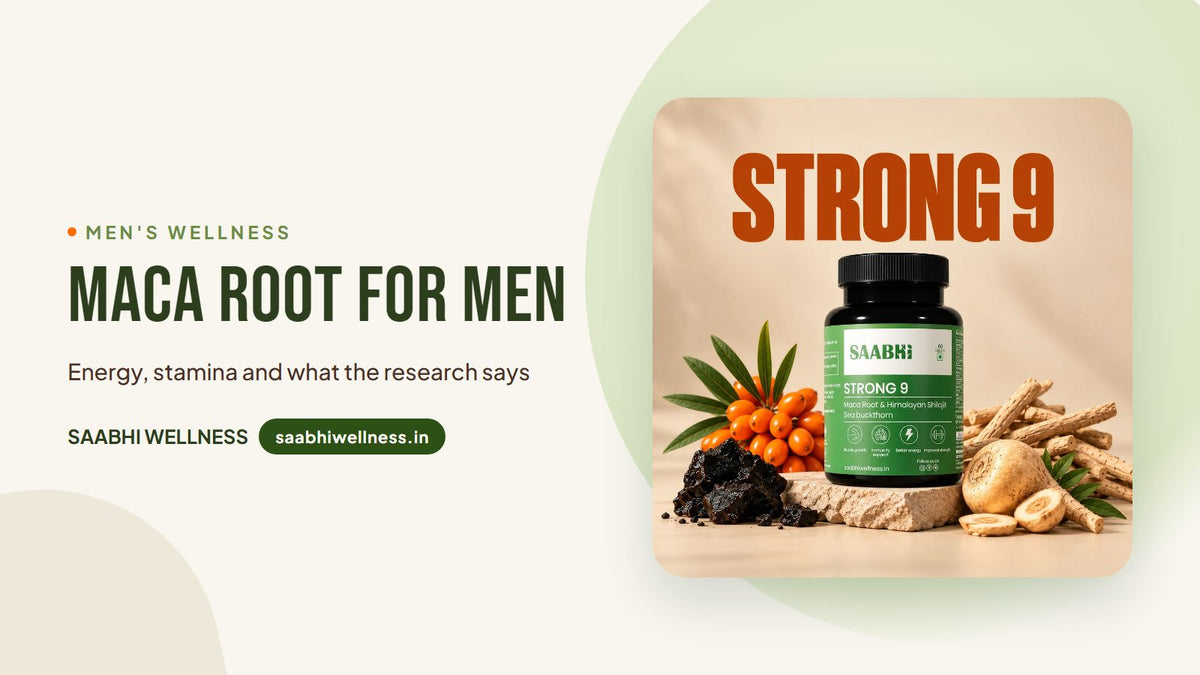
Maca is often sold as a natural energy and testosterone booster for men. Here is what maca is, what the studies actually found and how to read a label.
What is maca root?
Maca (Lepidium meyenii) is a root vegetable from the high Andes of Peru, where it grows at around 4,000 to 4,500 metres.
Andean people have grown it as food for centuries, cooking, baking or fermenting it and making it into porridge. It is not a traditional Ayurvedic herb, though it now appears in many Indian men's formulas. Researchers are most interested in compounds called macamides and glucosinolates, but their role in people has not been confirmed.
What are the main benefits of maca root for men?
Maca is mainly used for energy, stamina and general vitality, but none of these is firmly established in men. Most human studies are small and short.
- Energy and stamina: this is the traditional use, and the most common reason men buy it.
- Physical performance: pooled results look strong, but they lean heavily on animal tests.
- Testosterone: the often-repeated claim is not supported by the hormone trial described below.
Does maca really help energy and stamina?
It may, but the evidence in men is thin. In a pilot study of eight trained male cyclists, times improved after 14 days of maca extract compared with their own starting point, but not compared with placebo.
That difference matters, because riders often improve simply by repeating a test. No large trial has looked at everyday tiredness in working men. If you feel flat by evening, sleep, protein, movement and stress habits are the better place to start.
Does maca increase testosterone?
Going by the main trial, no. In a 12-week randomised, placebo-controlled trial, healthy men aged 21 to 56 took 1.5 g or 3 g of maca a day, and testosterone and other reproductive hormones did not change compared with placebo.
So be careful with any label that calls maca a testosterone booster. If you are worried about your levels, a doctor can order a blood test.
How much maca root should I take?
There is no agreed daily amount. The hormone trial used 1.5 to 3 g a day of gelatinised maca, so follow your product's label and be clear about how much it actually contains.
| Source | Amount and duration | What was seen |
|---|---|---|
| Hormone trial, healthy men aged 21 to 56 | 1.5 g or 3 g a day of gelatinised maca for 12 weeks | No change in testosterone or other hormones compared with placebo |
| Pilot study, 8 trained male cyclists | Maca extract for 14 days | Cycling time better than baseline, not better than placebo |
| Single-ingredient powder or capsule | Varies by brand; check the label | Compare the milligrams per serving with the amounts above |
| Saabhi Strong 9 (multi-herb tablet) | Maca Root 50 mg per tablet (100 mg a day), with 8 other botanicals | Not tested in these studies; a much smaller amount than the trials |
Whichever form you choose, take it consistently for 8 to 12 weeks before deciding how it suits you.
What does the research say?
The research is early and mixed. A 12-week randomised, double-blind, placebo-controlled trial found maca did not affect reproductive hormones in healthy men [1]. A small randomised crossover pilot in eight cyclists found no cycling advantage over placebo; self-rated sexual desire scores were higher than with placebo, in a very small group over a short period [2].
A 2024 systematic review and meta-analysis of 21 animal and human studies reported large effects on physical performance, stronger at higher doses, but its main outcomes included animal tests such as forced swimming [3]. A critical review concluded that maca's health claims cannot yet be fully supported, citing small samples, weak methods and concerns about product quality as cultivation has spread beyond Peru [4].
These studies used specific preparations and doses. None tested any Saabhi product, and they do not show that maca treats any condition.
- Gonzales GF et al. (2003). Effect of Lepidium meyenii (Maca), a root with aphrodisiac and fertility-enhancing properties, on serum reproductive hormone levels in adult healthy men. J Endocrinol. Randomised controlled trial. https://pubmed.ncbi.nlm.nih.gov/12525260/
- Stone M et al. (2009). A pilot investigation into the effect of maca supplementation on physical activity and sexual desire in sportsmen. J Ethnopharmacol. Randomised crossover pilot study. https://pubmed.ncbi.nlm.nih.gov/19781622/
- Huerta Ojeda Á et al. (2024). Effects of Maca (Lepidium meyenii Walp.) on Physical Performance in Animals and Humans: A Systematic Review and Meta-Analysis. Nutrients. Systematic review and meta-analysis. https://pubmed.ncbi.nlm.nih.gov/39796542/
- Beharry S et al. (2018). Is the hype around the reproductive health claims of maca (Lepidium meyenii Walp.) justified? J Ethnopharmacol. Critical review. https://pubmed.ncbi.nlm.nih.gov/28811221/
Who should avoid maca or check with a doctor first?
Maca is a food plant, but concentrated supplements have limited long-term safety data, so some people should ask a doctor first.
Is there an easy way to include maca every day?
A multi-herb tablet is one simple option if you want maca as part of a wider daily routine. Saabhi Wellness makes science-backed functional wellness drinks and supplements for stress, detox, gut, sleep and daily energy, in convenient daily formats with ingredients dosed for results.
Saabhi Strong 9 is a daily multivitamin for men with Maca Root 50 mg per tablet, alongside Sea Buckthorn 200 mg, Ashwagandha 100 mg, Gokshura 100 mg, Vidari Kand 100 mg, Moringa 75 mg, Shudh Shilajit 50 mg, Haritaki 50 mg and White Musli 25 mg. Take 1 tablet twice a day after meals.
Its daily maca amount (100 mg) is much lower than in the trials above, because it is one of nine botanicals, so don't expect it to match those studies. It is a daily wellness supplement, not a treatment. Explore the men's wellness range, or read about shilajit benefits for men.
Frequently asked questions
What are the benefits of maca root for men?
Maca is a Peruvian root traditionally eaten for energy and stamina. Small human studies are mixed, and much of the positive performance data comes from animal tests. It may support an active routine, but larger trials in men are still needed.
Does maca root increase testosterone?
The main evidence says no. In a 12-week placebo-controlled trial, healthy men taking 1.5 g or 3 g of maca a day showed no change in testosterone compared with placebo. Be cautious of labels that call it a testosterone booster.
How long does maca take to work?
There is no reliable timeline. Human studies ran from 14 days to 12 weeks, and results were mixed. It is not an instant energy source like caffeine, so give any product 8 to 12 weeks of daily use before judging it.
Can I take maca with shilajit and ashwagandha?
They are often combined in men's formulas. Saabhi Strong 9 contains all three, at Maca Root 50 mg, Shudh Shilajit 50 mg and Ashwagandha 100 mg per tablet. Check with your doctor first if you take regular medicines, and avoid doubling up on products.
Is maca safe to take every day?
Maca is eaten as a food in Peru, but long-term data on concentrated supplements are limited. Follow the label dose, choose a licensed maker that states the amount clearly, and speak to a doctor if you take medicines or have a health condition.