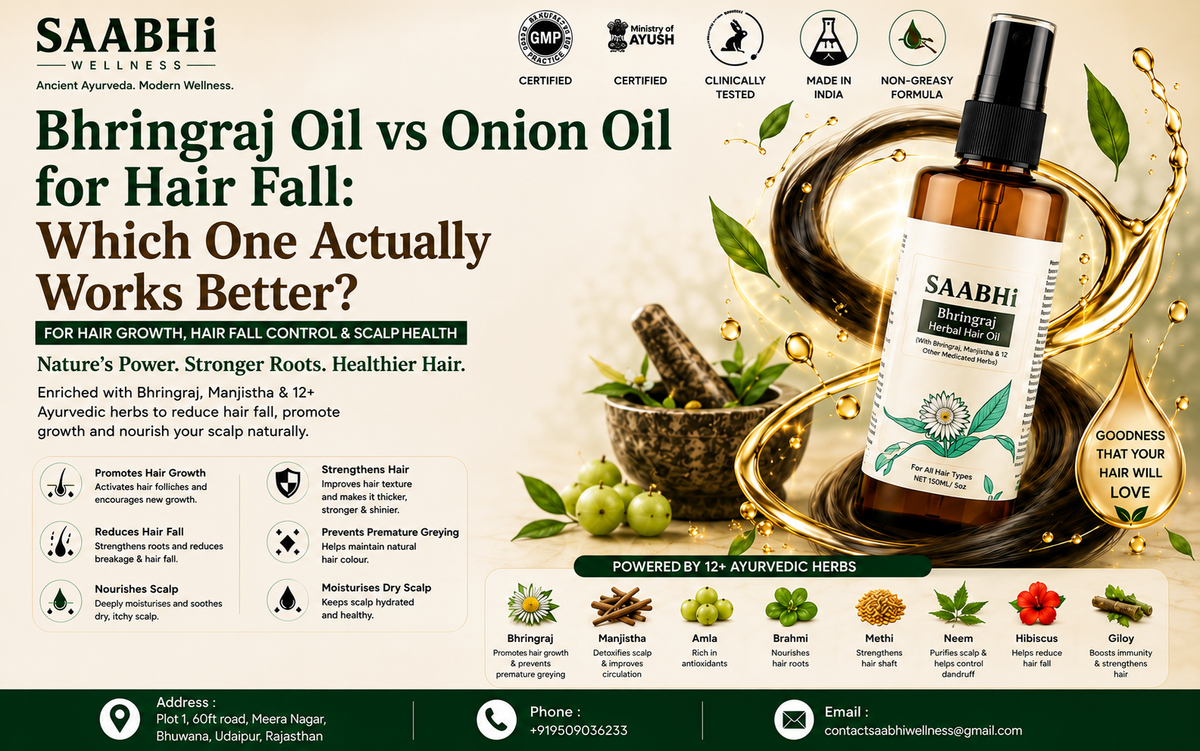
Walk into any pharmacy or scroll through any hair-care forum in India, and you'll find the same two names dominating the hair fall conversation — onion oil and bhringraj. Both promise thicker strands, fewer hairs on your pillow, and a healthier scalp, and both have loyal followers swearing by their results. But when you actually put bhringraj oil vs onion oil for hair fall side by side, the differences become obvious fast — in smell, in scalp compatibility, in how long results take to show, and in what each oil is genuinely doing at the root level. This article breaks down the science, the traditional use, and the real-world experience behind both oils, so you can choose the one that fits your hair type and your patience level. Along the way, we'll also look at why Ayurvedic brands like Saabhi Wellness have built entire hair-care lines around Bhringraj Hair Oil rather than onion, and what that choice says about long-term scalp health versus short-term shine.
What Causes Hair Fall in the First Place?
Before comparing oils, it helps to understand what you're actually trying to fix. Hair fall in most Indian adults isn't caused by one single factor — it's usually a mix of nutritional gaps, hormonal shifts, scalp inflammation, pollution exposure, and stress-triggered shedding. DHT (a byproduct of testosterone) is one of the biggest culprits, since it shrinks hair follicles over time and shortens the growth phase of each strand. Add in hard water, chemical-laden shampoos, and constant heat styling, and the scalp barrier weakens further, making hair more prone to breakage and thinning. This is exactly why topical oils matter so much in Indian hair care — a good oil doesn't just sit on the surface, it penetrates the follicle, calms inflammation, and either blocks or slows the processes that cause shedding. Both onion oil and bhringraj oil claim to do this, but they approach the problem from very different angles, which is where the real comparison begins.
Onion Oil for Hair Fall: How It Works
Onion oil became popular almost overnight a few years ago, largely because of its high sulphur content. Sulphur is a building block of keratin, the protein that makes up hair strands, and early research suggested that sulphur-rich onion extract could improve blood circulation to the scalp and support collagen production around the follicle. Some smaller studies on onion juice specifically (not always oil) showed improvement in hair regrowth for people with patchy hair loss, which is where much of onion oil's reputation comes from. The catch is that most commercial onion oils are heavily diluted with mineral oil or synthetic fragrance to mask the smell, which reduces the actual sulphur concentration reaching your scalp. Onion oil can also be quite harsh on sensitive or already-inflamed scalps, sometimes causing a stinging sensation or dryness with regular use, and the smell — even in "fragrance-masked" versions — is a genuine deterrent for many users who end up discontinuing it before results show.
Bhringraj Oil for Hair Fall: How It Works
Bhringraj (Eclipta Alba) has been used in Ayurvedic hair care for over a thousand years, earning it the title "King of Hair" in classical texts. Unlike onion, which works primarily through sulphur and keratin support, bhringraj's strength lies in its ability to calm scalp inflammation, block DHT activity at the follicle, and improve microcirculation so nutrients actually reach the hair root. This is one of the most well-documented bhringraj oil benefits for hair — it doesn't just sit on the surface layer, it works with the scalp's natural biology to slow shedding and support the follicle's growth cycle. Bhringraj is also cooling by nature, according to Ayurveda, which is why it's traditionally recommended for people dealing with scalp heat, stress-related hair fall, and premature greying — three issues onion oil doesn't directly address. When paired with a blood-purifying herb like Manjistha, as it typically is in traditional formulations, bhringraj also helps detoxify the scalp and reduce dandruff-causing buildup, giving it a broader range of action than a single-ingredient onion oil.
Bhringraj Oil vs Onion Oil for Hair Fall: Head-to-Head Comparison
When you line up bhringraj oil vs onion oil for hair fall on the factors that actually matter day to day, the gap becomes clearer. Here's how the two compare across the categories most people care about before committing to a routine.
-
Smell and everyday usability: Onion oil retains a lingering sulphurous smell even in "masked" versions, which many users find hard to live with daily, while bhringraj has a mild, earthy, herbal fragrance that washes out easily and doesn't require extra rounds of shampooing to remove completely.
-
Scalp compatibility: Bhringraj is gentle enough for oily, dry, sensitive, and colour-treated scalps alike, whereas onion oil can trigger stinging, dryness, or irritation on sensitive skin, especially when the concentration isn't properly diluted or the base oil quality is poor.
-
Speed and consistency of results: Onion oil's results tend to vary widely between users depending on formulation quality, while bhringraj oil shows a more consistent pattern of reduced shedding within three to four weeks when used regularly, since it works on inflammation and DHT rather than a single nutrient pathway.
-
Additional scalp benefits: Bhringraj addresses dandruff, scalp heat, and premature greying alongside hair fall, giving it a wider therapeutic range, while onion oil is largely a single-purpose remedy focused on keratin support and sulphur delivery.
-
Traditional backing and long-term safety: Bhringraj has centuries of documented Ayurvedic use with a strong safety profile for daily or near-daily application, while onion oil is a comparatively recent trend with less established data on long-term daily use.
Which One Actually Works Better?
When you compare bhringraj oil vs onion oil for hair fall directly, bhringraj comes out ahead — not because onion oil doesn't work at all, but because bhringraj tackles the problem from more angles: it calms inflammation, supports circulation, works against DHT, and cools an overheated scalp, all of which are common contributors to hair fall in Indian climates and lifestyles. Onion oil's benefits are real but narrower, largely tied to sulphur and keratin support, and its effectiveness depends heavily on formulation purity, which varies a lot between brands. For someone dealing with everyday hair fall linked to stress, pollution, or scalp inflammation — rather than a specific medical condition — bhringraj oil is generally the more sustainable, better-tolerated, and more broadly beneficial choice, especially when it's part of a consistent, well-formulated natural hair fall treatment routine rather than a one-off fix.
Why Bhringraj Hair Oil From Saabhi Wellness Stands Out
Bhringraj Hair Oil for Stronger, Healthier Hair
Reduce hair fall, nourish the scalp, and promote naturally healthy hair growth.
Buy Now
Not all bhringraj oils are created equal, and this is where formulation quality makes a real difference. Many Ayurvedic hair oils on the market dilute their bhringraj content with cheap mineral oils, cutting the herb's actual potency by a significant margin before it ever reaches your scalp. Saabhi Wellness's Bhringraj Hair Oil takes a different approach, using a high-concentration blend of Bhringraj and Manjistha infused through the traditional Tail Pak Vidhi process — a slow-cooked method that preserves each herb's therapeutic strength instead of stripping it out through fast, cheap extraction. The base is cold-pressed coconut oil, chosen for its lauric acid content, which penetrates the hair shaft and locks in moisture rather than just coating the surface. There are no mineral oils, silicones, sulphates, or parabens in the formula, and every batch is third-party lab tested, AYUSH approved, and GMP manufactured. This is exactly why, in the bhringraj oil vs onion oil for hair fall debate, formulation purity ends up mattering as much as the herb itself, and it's what makes this the best ayurvedic hair oil for hair fall for anyone tired of diluted, marketing-heavy alternatives.
How to Use Bhringraj Hair Oil for Best Results
Getting results from any hair oil depends as much on technique and consistency as it does on the formulation itself, so following a proper routine matters.
-
Warm and section: Warm two to three millilitres of oil between your palms and part your hair into small sections so the oil can be applied directly to the scalp rather than just the strands, which is where most of the active benefit actually happens.
-
Massage thoroughly: Massage the oil into your scalp using circular motions for five to ten minutes, since this step improves blood circulation to the follicles and helps the herbal actives absorb more effectively into the skin.
-
Leave it in: Let the oil sit for a minimum of one hour, or ideally overnight, so the Bhringraj and Manjistha have enough time to work on inflammation, buildup, and follicle nourishment before washing.
-
Wash off gently: Rinse with a mild, sulphate-free shampoo to avoid stripping the scalp of the oil's benefits, and repeat this full routine two to three times a week for consistent, cumulative results.
Building a Complete Natural Hair Fall Treatment Routine With Saabhi Wellness
Oil alone won't fix hair fall if the rest of your routine works against it, so think of bhringraj oil as one part of a broader natural hair fall treatment approach rather than a standalone miracle fix. Pair regular oiling with a sulphate-free shampoo, avoid excessive heat styling, and keep an eye on nutritional gaps like iron, protein, and biotin, which often contribute to shedding when left unaddressed. Stress management also plays a bigger role than most people realise, since cortisol spikes can push hair follicles into a resting phase prematurely, which is part of why Ayurveda treats bhringraj's cooling, calming properties as just as important as its circulation benefits. Consistency is the real differentiator here, and this is where the bhringraj oil vs onion oil for hair fall comparison really settles — most Saabhi Wellness users see a visible reduction in hair fall within three to four weeks of regular use, with new growth becoming noticeable around week six to eight, provided the oiling routine is paired with basic scalp hygiene and a reasonably balanced diet.
FAQ
Q1. Which is better for hair fall — bhringraj oil or onion oil?
Bhringraj oil generally works better for most people because it addresses inflammation, DHT activity, and scalp circulation together, while onion oil focuses mainly on sulphur and keratin support. Bhringraj also has a broader traditional safety record for regular, long-term use across most hair and scalp types.
Q2. Can I mix bhringraj oil and onion oil together?
Yes, some people combine both, but it's not necessary if you're already using a high-concentration bhringraj formulation, since it typically includes Manjistha for scalp detox. Mixing oils can also dilute overall potency, so a single well-formulated oil often works more effectively on its own.
Q3. How long does it take to see results from bhringraj oil?
Most users notice a reduction in hair fall within three to four weeks of consistent use, applied two to three times per week. Visible new hair growth typically appears around week six to eight, with a minimum ninety-day course recommended for lasting, noticeable results.
Q4. Does onion oil really smell that bad?
Yes, onion oil retains a noticeable sulphurous smell even in fragrance-masked versions, which is one of the most common reasons people discontinue use before seeing meaningful results. Bhringraj oil, by contrast, has a mild, earthy scent that rinses out easily without lingering on the hair.
Q5. Is bhringraj oil safe for oily and sensitive scalps?
Yes, bhringraj oil is lightweight, non-comedogenic, and generally well tolerated across oily, dry, sensitive, and colour-treated scalps. Unlike onion oil, which can occasionally cause stinging or dryness on sensitive skin, bhringraj's cooling, calming properties make it suitable for daily or near-daily application.
Q6. Does bhringraj oil help with dandruff and premature greying too?
Yes, when combined with Manjistha, bhringraj oil helps target dandruff-causing fungal buildup on the scalp and supports melanin production, which can delay and reduce premature greying. This gives it a noticeably broader range of benefits than single-ingredient onion oil formulations typically offer.
Q7. How often should I apply bhringraj hair oil for best results?
Two to three applications per week are generally recommended for optimal results, though daily use is considered safe if preferred. Consistency over several weeks matters more than frequency alone, since the herbal actives work cumulatively on scalp inflammation and follicle health over time.
Final Word
When it comes down to bhringraj oil vs onion oil for hair fall, bhringraj generally offers a more well-rounded, better-tolerated, and longer-documented solution, especially when the formulation is potent and free of dilutants. Onion oil isn't without merit, but its narrower scope and formulation inconsistencies make it a less reliable long-term pick for most people. If you're ready to commit to a consistent, Ayurveda-backed routine, Saabhi Wellness's Bhringraj Hair Oil offers the concentration, purity, and traditional processing needed to actually see results — not just a pleasant scent and a short-lived trend. Saabhi Wellness has built its hair and skin care line around this principle: real herb concentration over dilution, and traditional Ayurvedic method over shortcuts.