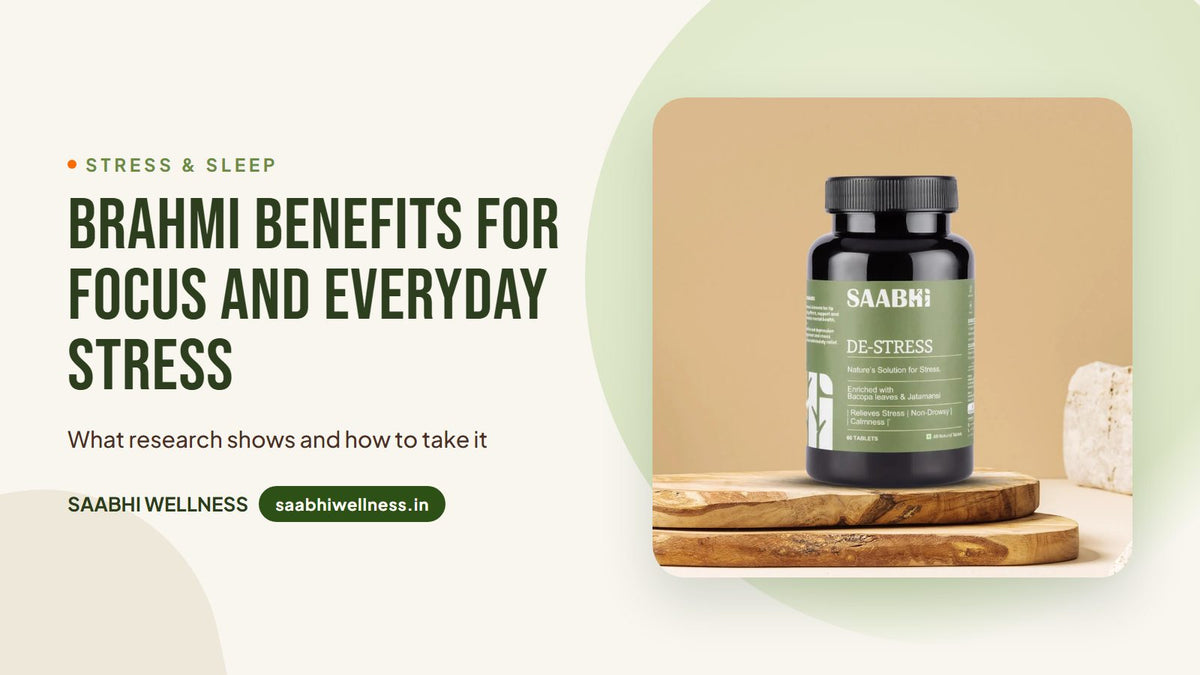
Long workdays and a phone that never stops buzzing leave many of us scattered by mid-afternoon. Brahmi is a herb Ayurveda has long used for this, and it has also been studied in modern trials. Here is what the evidence shows and how to use it sensibly.
What is Brahmi?
Brahmi is the common name for Bacopa monnieri, a small creeping plant that grows in wet, marshy ground across India. In Ayurveda it is classed as a medhya rasayana, a herb used to nourish the mind, memory and concentration.
In some regions "brahmi" also refers to mandukaparni (gotu kola), a different plant. This guide covers Bacopa monnieri, the herb most focus and memory research is on.
What are the main benefits of Brahmi?
Research on Brahmi has focused mainly on attention, processing speed and memory in healthy adults, with newer work on everyday stress.
- Focus and attention: a meta-analysis of controlled trials found faster performance on attention tests after 12 weeks or more of use.
- Learning and memory: one well-known trial saw better learning rate and memory consolidation compared with placebo.
- Everyday stress: a small study tested how people reacted to a demanding multitasking test after taking Brahmi.
- Traditional use: Ayurveda pairs Brahmi with shankhpushpi and ashwagandha for a steady mind.
How does Brahmi support focus and everyday stress?
Brahmi contains compounds called bacosides, which researchers believe drive most of its effects. Lab studies suggest they act as antioxidants in brain tissue and may influence the signalling chemicals involved in learning.
For stress, Brahmi is often grouped with adaptogens like ashwagandha. Human data here is still early, so treat it as one support for a calmer routine, alongside sleep, movement and screen breaks.
How does Brahmi compare with other calming herbs?
Brahmi leans towards focus and memory, while ashwagandha and jatamansi lean towards calm and rest, so Ayurvedic formulas often combine them.
| Herb | Traditional focus | What modern research mainly looks at | In Saabhi De-Stress Tablets (per tablet) |
|---|---|---|---|
| Brahmi (Bacopa monnieri) | Memory, concentration, a calm mind | Attention, learning and memory over 12 weeks | Processed (bhavana) with Brahmi 500 mg |
| Ashwagandha | Strength, resilience, rest | Perceived stress and sleep quality | 300 mg |
| Shankhpushpi | Mental clarity, calm | Mostly early and lab studies | 100 mg |
| Jatamansi | Calm, restful sleep | Mostly early and lab studies | 100 mg |
| Tagar (Indian valerian) | Relaxation, sleep | Related valerian species studied for sleep | 100 mg |
What does the research say?
A 2014 meta-analysis pooled nine randomised, placebo-controlled trials (518 participants) that used standardised Bacopa extracts for at least 12 weeks. It found faster attention-test results and quicker reaction times, and called for larger trials [1]. An earlier randomised trial in healthy adults found improvements in speed of visual information processing, learning rate and memory consolidation compared with placebo, with the largest effects at 12 weeks [2]. A small crossover study in 17 healthy volunteers gave single doses of 320 mg and 640 mg of a Bacopa extract before a stressful multitasking test and reported some positive mood effects and lower cortisol; the authors said this needs to be repeated in larger groups [3].
These studies used specific standardised extracts and doses, mostly in healthy adults. None of them tested any Saabhi product, and they do not show that Brahmi treats any condition.
- Kongkeaw C et al. (2014). Meta-analysis of randomized controlled trials on cognitive effects of Bacopa monnieri extract. J Ethnopharmacol. Meta-analysis. https://pubmed.ncbi.nlm.nih.gov/24252493/
- Stough C et al. (2001). The chronic effects of an extract of Bacopa monniera (Brahmi) on cognitive function in healthy human subjects. Psychopharmacology (Berl). Randomised controlled trial. https://pubmed.ncbi.nlm.nih.gov/11498727/
- Benson S et al. (2014). An acute, double-blind, placebo-controlled cross-over study of 320 mg and 640 mg doses of Bacopa monnieri (CDRI 08) on multitasking stress reactivity and mood. Phytother Res. Small randomised crossover study. https://pubmed.ncbi.nlm.nih.gov/23788517/
How should I take Brahmi?
Take Brahmi daily, after a meal, and give it at least 8 to 12 weeks. The trials that showed benefits ran for about 12 weeks, so a few days is not a fair test.
- Take it after food: Brahmi can upset the stomach on an empty stomach.
- Be consistent: same times each day, morning and evening.
- Pair it with habits: 7 to 8 hours of sleep, screen breaks and a daily walk.
Who should avoid Brahmi or check with a doctor first?
Some people should speak to a doctor before taking Brahmi, and some notice stomach upset, such as nausea or loose stools, especially on an empty stomach.
Is there an easy way to take Brahmi every day?
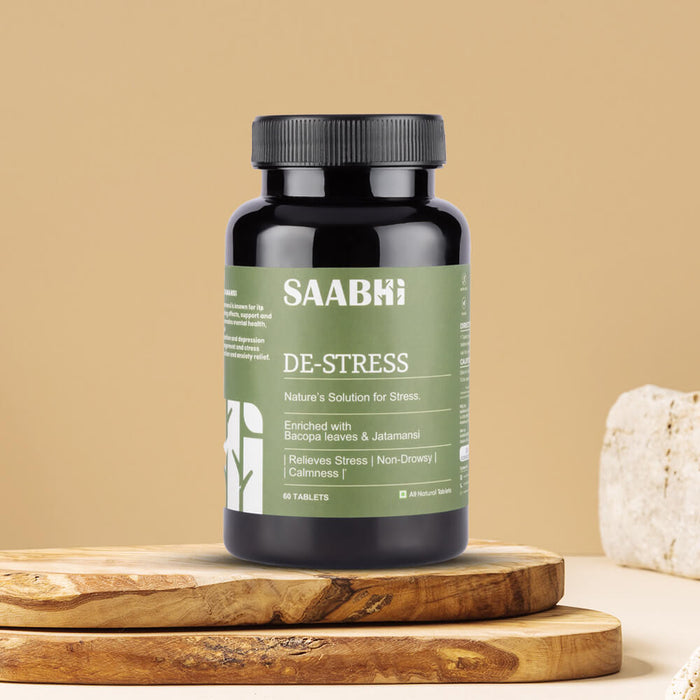
Saabhi Wellness makes science-backed functional wellness drinks and supplements for stress, detox, gut, sleep and daily energy, in convenient daily formats with ingredients dosed for results. Saabhi De-Stress Tablets are processed (bhavana) with Brahmi 500 mg per tablet and combine it with Ashwagandha 300 mg, Jatamansi 100 mg, Tagar 100 mg and Shankhpushpi 100 mg.
Take 1 tablet twice a day after meals. They are for adults 18 and over, and they are a daily wellness supplement, not a treatment. Explore the full stress and sleep range, or read how cortisol affects your daily energy.
Frequently asked questions
What are the benefits of Brahmi?
Brahmi (Bacopa monnieri) is an Ayurvedic herb traditionally used for memory and focus. Trials of standardised extracts taken for about 12 weeks suggest it may support attention, learning and memory in healthy adults. Early research is also looking at how it affects the body's response to everyday stress.
How long does Brahmi take to work?
Brahmi works slowly. Most trials that found benefits for attention and memory ran for around 12 weeks, so give it at least 8 to 12 weeks of daily use, taken after meals, before judging how it suits you.
Is Brahmi the same as gotu kola?
No. Brahmi is Bacopa monnieri. Gotu kola (Centella asiatica, mandukaparni) is a different plant that is sometimes also called brahmi in parts of India. Most focus and memory research is on Bacopa monnieri.
Can I take Brahmi with ashwagandha?
Yes, Brahmi and ashwagandha are often combined in Ayurveda: Brahmi for focus and ashwagandha for resilience and rest. Saabhi De-Stress Tablets include both. Check with your doctor first if you take regular medicines or have a thyroid condition.
Who should not take Brahmi?
People who are pregnant or breastfeeding, have a thyroid condition or stomach ulcer, or take medicines for thyroid, mood, sleep, epilepsy or blood pressure should speak to a doctor before taking Brahmi. Saabhi De-Stress Tablets are for adults 18 and over.